The Common University Entrance Test (CUET) has transformed undergraduate admissions across India’s central and participating universities. With over 15 lakh registrations in recent cycles and intense competition for seats at top institutes like Delhi University, BHU, and JNU, among others, the stakes for CUET 2027 are already high. The exam, likely to be held in May 2027, is designed to test language skills, domain subjects drawn largely from the NCERT Class 11-12 syllabus, and a General Aptitude Test through computer-based multiple-choice questions.

At this early stage, students aspiring to appear for the 2027 exam must be planning their broad preparation timeline, if they should consider coaching or prepare at home, and other important decisions that will help shape their exam strategy. Therefore, if you are in Class 11 or the beginning of Class 12, you have a rare advantage: nearly a full academic year (or more) to build depth rather than scramble. But the question still remains: should you choose self-study, online coaching, or offline coaching? Hitbullseye has curated this article specifically for those who are contemplating the right choice; we aim to give you an honest comparison to help you decide…
The honest answer is that coaching is not mandatory. Early CUET toppers and many successful candidates have cleared the exam through disciplined self-study, focused on NCERT textbooks, previous-year papers, and free online resources. Yet the data and lived experiences of thousands of aspirants clearly show that structured professional guidance significantly raises the probability of achieving high percentiles and preferred college admissions. Coaching supplies what most school classrooms and solo efforts struggle to deliver consistently: exam-specific strategy, regular performance diagnostics, and experienced academic mentorship.
CUET Free Master Classes:
Why Coaching Can Improve Your Chances?
CUET rewards precision under time pressure and negative marking more than raw knowledge. Schools prioritize board examination patterns; they rarely train students in the exact question formats, speed-accuracy trade-offs, or subject combinations demanded by specific university programmes. Experienced CUET faculty, by contrast, reverse-engineer the paper, map NCERT chapters to high-weightage topics, and teach students when to attempt versus skip.
Regular full-length mocks with detailed analysis expose weak chapters early. Peer competition and mentor accountability keep motivation from evaporating during the long dual preparation of boards and CUET. Surveys of competitive-exam toppers (including CUET cohorts) consistently show that a large majority, often estimated at 70–80 % when hybrid models are included, benefited from some form of guided preparation. Pure self-study succeeds, but it demands exceptional self-discipline that most 16-18-year-olds find challenging to sustain for 12-18 months. Professional guidance compresses the learning curve and reduces costly trial-and-error.
Starting early amplifies these benefits. Students who begin in Class 11 can complete conceptual coverage once, revise multiple times, and attempt 30-40 quality mocks before the exam window. Those who wait until after boards often face a compressed, high-stress cycle.
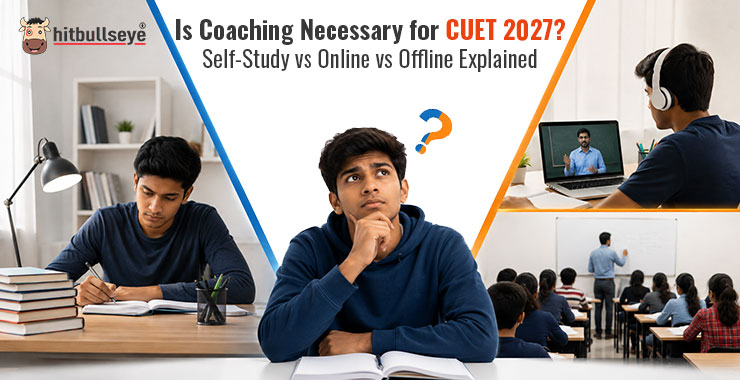
Online Coaching vs Offline Coaching vs Self-Study: A Clear Comparison
The following points help you understand how these three main pathways stack up on the factors that matter most at this early stage.
Cost
Self-study is the cheapest route: ₹3,000-7,000 covers NCERT books, a few reference titles, previous-year papers, and a basic test series. Online coaching typically ranges from ₹15,000-50,000 for a comprehensive 10–12-month programme, including live and recorded classes, mocks, doubt support, and material. Offline classroom programmes usually cost ₹30,000-1,00,000 or more in metros. Online options therefore deliver most of the professional structure at a fraction of the offline price, however, this is ideal if self-discipline and consistency can be maintained by one.
Flexibility
Self-study offers total freedom. You set the timetable, pace, and subject priority. Online coaching comes close: recorded lectures can be watched at convenient hours, difficult topics rewound, and school or board schedules easily accommodated. Offline coaching is the least flexible. Fixed class timings, travel, and the risk of missing sessions create friction, especially for students juggling Class 12 boards. Therefore, the factor of flexibility is highly subjective according to the respective individual; if you are someone who is highly disciplined and confident about their preparation and just needs some resources to prepare well, self-study or online coaching is for you, however, if you need professional guidance and a strictly structured routine, offline coaching could be the right choice for you.
Results and Learning Outcomes
Pure self-study produces toppers every year when students maintain ironclad discipline and choose their resources wisely. Offline coaching can create a powerful competitive atmosphere and immediate face-to-face doubt clearing, yet large batch sizes often dilute individual attention. Online platforms that combine live interaction, recorded content, AI-driven analytics and structured mentorship have closed the quality gap; many now report stronger average outcomes because every student receives personalised progress tracking.
The real winner, according to multiple analyses of topper strategies, is a hybrid model: professional coaching (preferably online or blended) for concept clarity, strategy, and mocks, paired with rigorous self-study for revision and extra practice. This combination maximizes both structure and ownership.
What Should You Finally Choose?
- Choose pure self-study if you already possess strong conceptual foundations, proven self-discipline, and a track record of independent learning. You are comfortable creating and sticking to a detailed plan and budget is a hard constraint. Supplement with free YouTube channels, official NTA resources, and a high-quality paid test series.
- Choose online coaching if you want professional guidance without the logistical burden or high cost of classroom programmes. It suits most Class 11/early Class 12 students, those living outside major coaching hubs, and anyone who values the ability to revisit lectures. Modern online programmes give access to experienced faculty across India, regular CBT-style mocks, and performance analytics are advantages that translate directly into higher accuracy and better rank.
- Choose offline coaching only if you know you need external accountability, thrive in a physical classroom environment, and can access a reputable centre with small batches and strong faculty. The peer energy and real-time interaction can be transformative for students who otherwise procrastinate, but the cost and reduced flexibility make it a secondary option for most early starters.
For the majority of aspirants targeting competitive scores for top colleges, online or hybrid coaching currently offers the best risk-reward balance. It embeds experienced academic knowledge into daily preparation while preserving the flexibility required to balance boards.
A Practical Advice for CUET 2027 Aspirants Starting Now…
Map your target universities and required subject combinations immediately. Master NCERT thoroughly, as domain questions remain heavily rooted in it. Begin a light but consistent General Test routine. Introduce full-length mocks early, even if scores are modest; analysis matters more than the number. Reassess every three months: if motivation or clarity is slipping, add structured coaching rather than waiting until the final six months.
Remember, coaching does not replace hard work. It multiplies it. The students who treat professional guidance as a roadmap, then put in focused self-effort, consistently outperform those who rely on either extreme alone.
CUET 2027 is still a good stretch away. That time is an asset only if used deliberately. Self-study can get you across the line. Coaching, especially well-designed online or hybrid programmes that deliver experienced faculty and diagnostic practice, dramatically improves the odds of landing the college and course you actually want. At this early stage, the smarter question is not “Is coaching necessary?” but rather “How can professional guidance accelerate the preparation I am already committed to?” The answer, for most serious aspirants, is clear. What is it for you?

 E-305, Industrial Area, Sahibzada Ajit Singh Nagar, Punjab 160055, IN








.jpg?null)